Vegetated Shingle
Lancing Beach to Shoreham-by-Sea
The stretch of beach running from Lancing to Shoreham-by-Sea supports one of the rarest coastal habitats in the world: vegetated shingle. While shingle makes up around a third of England — s coastline, most of it is too mobile and unstable to support plant life. Here, above the high tide line, the shingle has stabilised sufficiently for a specialised community of plants to take hold — species adapted to survive in the harshest of conditions, where there is almost no fresh water, little soil, fierce salt winds and periodic inundation by the sea.
The most prominent pioneer is Sea Kale (Crambe maritima), whose deep fleshy roots anchor it into the stones, but the beach also supports Yellow Horned Poppy, Sea Campion, Red Valerian, Viper — s Bugloss, Thrift, and Kidney Vetch, as well as small colonies of Starry Clover — a plant found at only a handful of sites in the UK, of which Lancing beach is one. When the Sea Kale and Red Valerian come into bloom in late May or early June the reserve looks spectacular. In recognition of its ecological significance, Shoreham Beach was designated a Local Nature Reserve in June 2006, and forms part of the Brighton and Hove Biosphere — the only Biosphere in the world to include both Marine and Urban areas. The habitat is also important for invertebrates, and the vegetated shingle plants on the coastal strip offer vital food and shelter for a range of wildlife from insects to birds, and can often be the first stopping point for tired migrants that have made the crossing from the Continent.
Images
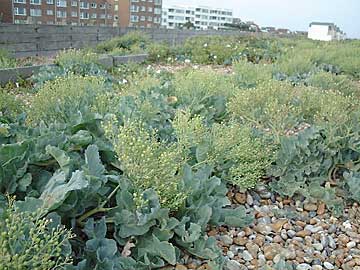
Crambe maritima
Sea Kale on vegetated shingle
Notable plants recorded on Lancing & Shoreham shingle
Plants
- Crambe maritima — Sea Kale
- Glaucium flavum — Yellow Horned Poppy
- Silene uniflora — Sea Campion
- Centranthus ruber — Red Valerian
- Echium vulgare — Viper — s Bugloss
- Armeria maritima — Thrift
- Anthyllis vulneraria — Kidney Vetch
- Trifolium stellatum — Starry Clover (very rare in UK)
- Cymbalaria muralis — Ivy-leaved Toadflax