Widewater Lagoon (LNR)
Local Nature Reserve · TQ 196 041 · Lancing, West Sussex
Contents
On this page
Related pages
Overview
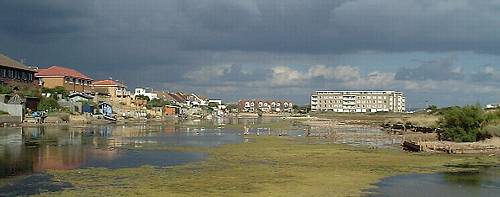
Widewater Lagoon
Widewater has special SNCI (Site
of Nature Conservation Importance) status as a unique
saline lagoon, and is the subject of an Action Plan by the
Sussex Biodiversity Partnership. The brackish lagoon was
formed in about 1840 when an embankment was constructed on
the south side of the coast road. The shingle bank to the
south was formed by longshore drift, which extended
across the mouth of the River Adur and formed the present
harbour entrance.
The embankments
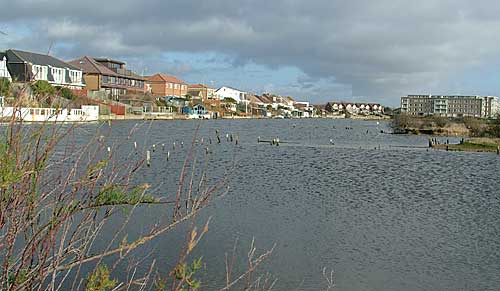
Southern embankment
All of the northern embankment
has been developed. The southern, shore-side embankment is
grassy with clumps of wind-stunted shrubs such as Elm and
Hawthorn. Among the herbaceous plants growing in the
well-drained, exposed conditions are:
Teasel · Coltsfoot · Burdock · Smooth Hawk's-beard · Prickly Oxtongue · Sea Mayweed · Pineapple Mayweed · Common Fleabane
Migrant butterflies
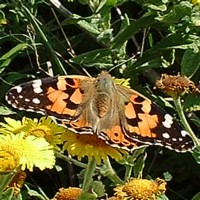
Vanessa cardui
Painted Lady
Incoming autumn migrants
appreciate the clumps of Fleabane on the embankment as
their first meal on British soil after the Channel
crossing.
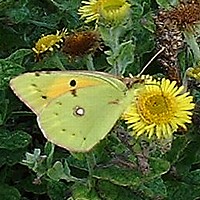
Colias croceus
Clouded Yellow
In August 2000 a large influx of
Clouded Yellow butterflies appeared in Shoreham and
Lancing. Many were sighted on the vegetated area of the
lagoon embankment. Similar sightings were reported across
much of southern England that season.
The aquatic life of Widewater Lagoon is
covered in more detail on Andy Horton’s Widewater Lagoon pages.